Nandi Thota

nandi-rock

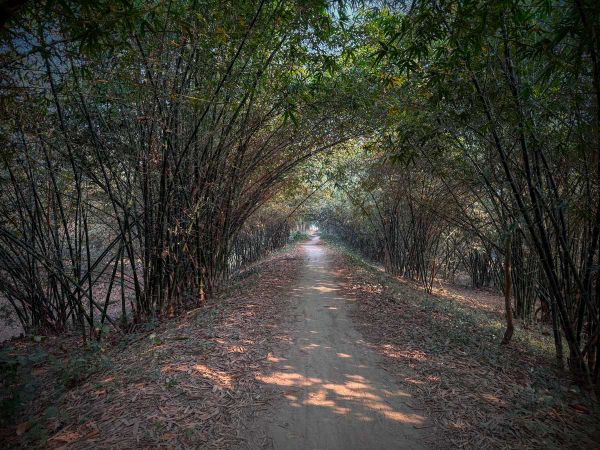
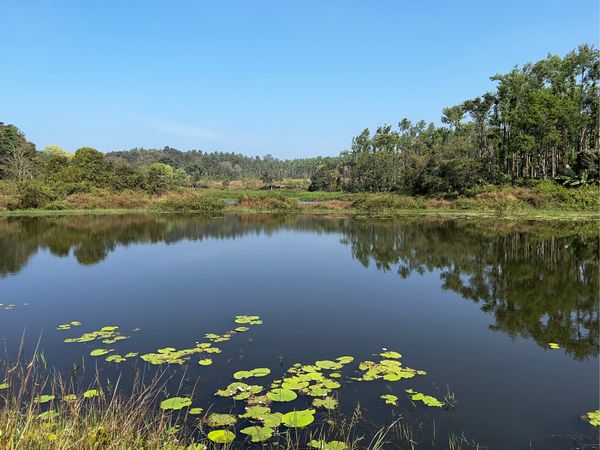
We were checking the repairs done on the fence in the east where we came upon these rocks whose story our writer told us.

A bull went grazing up the slopes beyond the stream that flows by these rocks. Those were days when the village by the stream did not exist and thick jungle covered the slopes and all the hills behind them. After a while the bull sensed eyes on himself and looked up and froze: a tiger stood crouched in the distance, ready to run at him. Our bull recovered and turned and fled down the slope and the tiger bounded after him. The bull crossed the stream whence he came, with life's end on his mind, and the tiger prepared to leap from a low ledge over the stream on to the bull's back. Just then a light shone from an opening among the rocks before the bull—a soothing light, a beckoning gleam. The tiger leapt and the bull shot into the crevice, and was engulfed by a heavenly heat, and he felt himself melting, melting, merging into Mahadeva, and was soon transformed into a rock-statue of Nandi, bull of Shiva-Mahadeva.

Now, villagers offer daily prayers to the deity in this crevice. What became of the tiger, the writer didn't say, but tigers never win in our cow and bull tales. Anyway, we now have a story to add depth to the name of our Nandi Thota.
|

Getting to know…

trees-trimmed


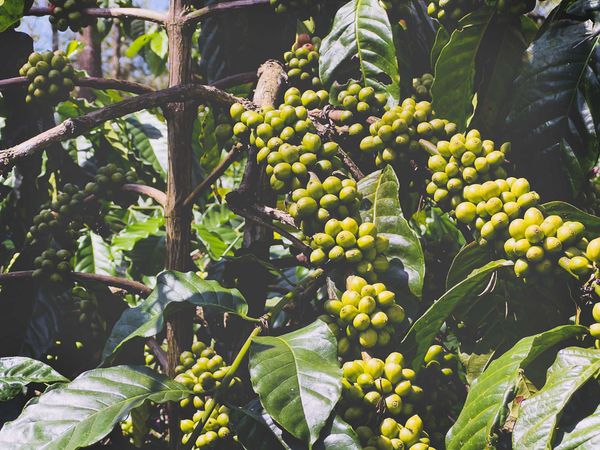
Dharmappa found our plantation for our property agent. A powder crumb of what we paid the agent went to Dharmappa, which he knows, so he is looking for how to make more money off us. One idea has been to get labor, whom he offers to transport in his jeep, squeezing fifteen humans into an open vehicle that should take six. Our writer proved him uncompetitive by hiring hands from the next village—no cost for transportation, no commission. Dharmappa is enraged at the writer because he (Dharmappa) hired him for us. Dharmappa wants the writer out, and though the first of the events that led to the fallout between them happened many days ago, Dharmappa’s anger won’t abate, and it looks to me that an emotional eruption has to happen for their relationship to resume.

He telephoned us to say Muthappa is not really a Coorgi. “He is a Malayalee and he is masquerading as a Coorgi.” Since it is not apparent to us how a Coorgi would manage a plantation differently than a Malayalee, we have not reacted. Dharmappa came calling last week and we asked him to be patient, that there would eventually arise some business that we could give him. He nodded sideways, fidgeted, and brought up the issue of the writer. “He is corrupt. Call the manager of his last employer, you’ll know.” “Corrupt how?” “I don’t know; something about coffee; call them; I don’t want you to blame me later, that I brought you a bad man.”

Dharmappa has full black hair and a front row of sparkling teeth but his skin holds promise: it is aged and creased and the deep lines surely hold stories from South Kanara from where he came to Sakleshpur, from his tenure in a Bangalore factory, from years as a driver in a plantation, from his present entrepreneurship, supplying labor, transporting labor, participating in real-estate deals and—as I see him building up against our writer—from his squabbles in which he’ll go to any length.

He smiles easily. His face keeps up a deference toward us while his tongue bristles at our writer. When annoyance comes up in me I remind myself that he is saving up for a heart operation at Narayana Hrudayalaya in Bangalore.

“His hands and legs were beaten until broken. He’s fled here from his village after that happened,” he said. The writer told me such a story about himself during our very first meeting, but my mind had wandered while he spoke, and now I’m surprised I didn’t pay attention then.

Our writer, I have seen, is a fine hand; I enjoy how he cuts off thick branches and hacks them into stakes, how his lean hand clears branch and thistle that block our path with single oblique hacks; he has a fine family; he keeps neat accounts; he talks too much, but then, he is bold and he is often right. Dharmappa has his fingers deep in village affairs and I have use for him so I’m not ready to end this budding relationship with him.

I want them both.

We parted agreeing to meet next week. Dharmappa called after us: “you’re paying your writer too much; the other planters are going to be angry with you.”
|

Why did you come here?

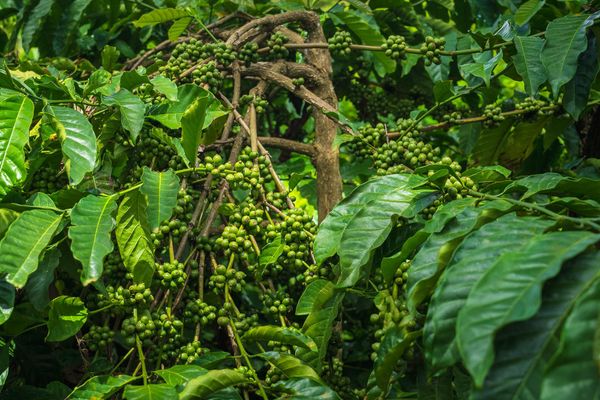
coffee-beans

He sat down, rested his vanity bag on the shelf formed by his belly and after he’d arranged the stuff from the bag about him he considered us who were sitting before him. We’d been waiting a short while from ten-thirty, the time we'd been told he arrives for work. He raised his brow.

We told him we need help to improve our plantation which we’d bought two weeks ago.

He bent left and searched for something and bent right and didn't find it. “It is not a good time; young workers have left for BPOs; stem-bore is rampant here; in the last picking season labor was so short berries fell unpicked; fallen berries are spreading disease—why did you choose this business?” He’d been smiling through the litany; he smiled still.

"Bangalore has throttled us; the only places we can be in Bangalore are home and our factory."

“I’m retiring, and I’ll settle in Bangalore!” he said with self-assurance and happiness and a tinge of amusement on his face.

We came to our questions.
“Can we use mechanization?”
“Not in Indian plantations. Brazilian plantations are designed for mechanization; not ours.”
“How do large planters manage labor-shortage? The Tatas? Amalgamated?”
“Mechanization.”

We asked about the stem bore. We’re told they fly from plantation to plantation and cause epidemics.

“Is Ballupet threatened by it?”
He laughed a silent laugh that shook his flesh. “It is the epicenter!”
“And Sakleshpur?”
“Too! And Chikmaglur! And Coorg!”
I tried to imagine the geography of this coffee belt where, if all the region is infected, would Ballupet be epicenter? The map wouldn’t form in my mind.
High on the wall hung a chart with concentric circles and small legends. Its header said it was a plan to combat stem bore.

We changed the subject: “You must’ve had a thrilling career.”
“Yes, I’ve worked all over India, even in the North East. I have a wide jurisdiction; sixteen officers report to me.”
“We are committed to our new career as planters. What is your advice?”
That silent laugh again. A laugh children and grandchildren would love.
“You make your decision. I won’t discourage you.”

We mentioned our factory in Hassan. A shadow came upon his face and took time to leave. “Factories are why agriculture is losing labor,” he said.

His mirth returned.

“Do you have a book that teaches about growing coffee?”
He pulled one from a depth in his table and held it up and away, its cover facing us.
“It is the only copy here. We are printing an updated edition.”
“Can we take this one? Please?”
“You can get one from our office in Sakleshpur.”

He gave us addresses: of that office, and of scientists in the research centre in Chikmaglur. He gave them himself, unlike others who direct visitors to subordinate staff.

We descended one steep flight from his cool room to where his staff sat, went down a second level, and stepped into the summer blaze.

Photo Courtesy: ۩۞۩~OTH~۩۞۩

|

A negotiation with a villager…

…was not easy.

I needed a small piece of land on the North to gain access to the “highway”. Some barren land, whose Eastern edge is mere marsh during monsoons. I threw a price that I’m sure was reasonable. He threw back a stunning counter-offer. Then he socked me, saying he has an offer from a stone crusher. A noisy, dust-raking operation by my plantation! I abandoned all rules of navigating a negotiation and ran to him.

The old man said I needn’t worry, that I’ll congratulate myself in six months that I got a fantastic bargain. We sat two hours; he nursed an orange juice; I sipped a coffee. I went up 50%. He came down 2%. I went up 100%. He climbed down 5%. We closed the deal.

I await the end of six months.
|

First brush

Sujaya and I went shopping for stuff for the plantation. "Beware the fertilizer," we'd been told. "It is often out of stock." We went to the Tata Plantation Supplies in Sakleshpur. It is a quiet store on a yard behind a busy bus-station. The name of its manager is Muthapa, a serene young Coorgi who speaks only as much as necessary.
trees

The fertilizer had been equal to its reputation and was sold out three days ago. We began working out the alternatives so that we have it when the rains come and wet the soil—that's when to apply the fertilizer. A man came in who wore an Adidas cap that emphasized his baldness by concealing it. He pulled a sheet of paper from Muthapa's table without asking, similarly took Muthapa's diary for use as a pad, and took brusquely over. We sat muted before Muthapa who twiddled his pen and raised his face to the newcomer.

The man’s technique to dominate was to speak from deep in the throat every time I tried to take back my transaction to where he'd interrupted it. The method worked well—Muthappa was forced to pay attention only to him. Our writer stood by the man's side and tried to break in, at which unpardonable impudence the voice inflected and went deeper still, his head cocked to an angle, and his well-built torso turned an imperceptible inch edgeways toward the writer and paused and returned. The head held its angle.

He wrote down prices pulling each item from a long checklist in that head. Muthappa tried coming back to me between the man's questions, but the man wouldn't have any of it. "It's okay, please finish with him," I told Muthapa, and searched the man's face for some contrition. There was none, and he went on. Such a long list he had! Our writer tried to move in a second time. This time the voice shot lower and sharpened and twisted. "Let him finish," I told the writer.

"I'll go back to Ballupet and send my truck," the man said, when done. "I don't load these things in my Jeep." I looked out the barred window into the yard, saw his Jeep parked by my car. It was fresh and clean and bright in the noonday sun, much like its owner, who looked as though he'd just stepped out of the shower and dressed in clothes newly arrived from the laundry. Even his sports watch with its large dial and plastic strap shone like new.

He did not look at me at any time, not even while leaving.

Only one other planter came in while Muthappa pleasantly resumed our business. This one's clothes were laundry fresh also; his shirt fell over the trousers; a shiny black mustache was prominent on his clean red face—he barged in too, but shyly, and he inquired for only the fertilizer and left.

The visit ended well. Muthappa accepted a cheque on this very first visit, and offered credit for next transactions. The writer got himself a load of the other things he needed which filled a small truck. We left the place three happy people.
|

far from…


thota


“Have you bought a gun?” Kanva asked me.
“Whatever for?”
“Here in Sakleshpur, we don’t talk much. We shoot if things drag beyond a point.”

I have heard such a line many years ago, delivered by Eli Wallach just after he shoots down a too-talkative attacker while bathing in a small wooden tub holding a gun beneath overflowing soap bubbles*. Kanva isn’t the type to watch The Good, The Bad, and The Ugly; besides, Kanva is very young and the movie is too old. I gazed at him and wondered: In Sakleshpur they are unlike in Bangalore: they speak softly even if they are built well; they don’t glare when you come up against them on the road; they don’t thrust accusing hands at you; and they take you into their homes and serve delicious food hot with pepper from their own plantations, and coffee with milk-froth on top, with powder from beans grown in their own vast backyards.

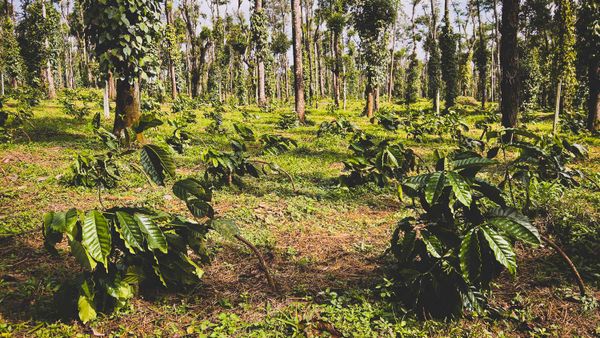
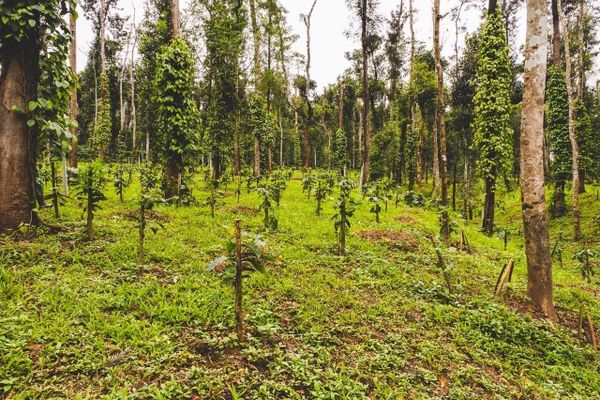
Such a plantation Kanva has sold me, and we were at dinner the night of the purchase (last week) when he spoke about guns. The day before he had taken me to a darkness in the plantation covered over by thick branches, where dark-brown and black old rocks are arranged, and the rocks are pasted over with prayer marks and flowers. Goddess Chowdi: No murthi, just a humbling, mysterious, fearsome presence suggested by the darkness and the rocks and the knowledge that for decades people from the village are sacrificing goat there before Chowdi on severely composted black and wet soil.

And yesterday while Sujaya and I inspected the plantation with our writer, some ten strange young men walked three tracks ahead of us, all within our boundary. “To shoot wild pig,” the writer told us, reading the question-mark on our face. Three of them carried long rudimentary guns, and three or four dogs of poor pedigree but enough discipline went with them and the group disappeared.

I have a task ahead of me: I am vegetarian and I will not have guns and blood on my land in my brand new home. But see the picture above and you’ll know I’ve related only one part. See also these pictures.


* As I remember. My memory is often mischievous.
|

Last day in Phoenix

The sky rules. It's a clear-blue holiday-sky, stretched wider and higher than at home and pulled smooth behind low ragged hills. I see plunged-down sky wherever I turn. I cannot say why I like the color of these hills; they sport a sort of brown and a sort of green either of which when I consider separately I do not like. Near me, through the window of the cab, shrub, short desert plants, tall Arizona cactus, light-colored gravel, and a sense of clean I have not felt in even the affluent spots in India. And this is a desert town.

My destinantion is the Biltmore Fashion Center. The Apple Center belongs very well in it. I linger long and ache before the iPhone, but I can buy only the Touch—Apple won't say when the iPhone will work officially in India. And I lift and weigh and hug and squeeze and open and close the Apple Air, again and again. I say "no, thanks" to many offers to help. At Borders, I sip cappuccino and skim Three Cups of Tea and I buy my first Noam Chomsky: What we say goes. I am introduced by the large bearded man at Information to Truman Capote, and I add Tiffany's and Portraits and Observations.

I've enjoyed the short visit and today is the day to leave and I'm filled with that I-don't-wanna-go-home feeling.

apple-center
|

the war

I remember the day the war was won. I tossed the ball to Sidda and asked for the latest on it. “Oh, we won,” he said, in the way one would’ve said that India had won a test match.
tank1
But we were thrilled for many days after that, reading about the successes of the Gnat and of heroism such as that of a captain in our navy who had sat and lit a cigar on the deck of his bombed and evacuated ship and had sunk with it. On our public grounds they asked the only war hero from our town to make a speech, and he said he could fire away at the enemy but he didn’t have the courage for the stage and the microphone. An overwhelming awe for Indira Gandhi gripped us. She came to our town a few months later, and we went to see her, and I remember walking over the bridge above the railway lines outside the fort walls with Sidda and the son of appaji’s peon. “This bridge belongs to Indira Gandhi! This road, those trains, bogies, all these trees, everything!” the son of the peon had exulted. “Even this!” he had cried, picking a fistful of very-dry very-fine grey mud from the edge of the road where the jaali thorns grew. The mud fell steadily from between his bony fingers and fine dust from it blew into our faces. More dust hit our nostrils when he clapped his hands clean.
|

Pet Peeves

I have managed for decades with toothpaste, soap, and shampoo, and I've been alright, except that I'd rather have them brought home for me and kept where I can find them. Now we have two little fellows who
petcare
don't ask for these things, and would rather not be given them, but here is a long list of items that are available for them that I am working through: “shampoo, rinse, anti-dandruff shampoo, coloring, temporary coloring, ear cleaner, oral refresher, eye cleaner, tear stain remover, aroma deodorant, cologne, anti-germ, movement leading spray, coat conditioner and coat styling spray for the markets of foreign countries as well as Korea.” I obtained the url of the Korean pet company (whose goods fill the shelves of the friendly pet store) from the carton of “Good Puppy Movement Leading Spray”—a concoction which holds more relief for me than for my new pets whose bowels this spray will unloose at the spot of my choosing.

Then, in a note on their site written for Man but directed at Dog, the Managing Director of the Korean pet company says: “Accordingly, our customers of pet mania are always satisfied with ForBis products as their pets feel ease and comfort, and look healthier with our products whenever they have been treated with. Especially, our Temporary Coloring product which nobody can imitate in the world is manufactured by our unique technology with know-how, and is very good and useful for the reception ceremonies and events like Halloween day as the various colors can be changed temporarily, easily and anytime whenever the color change is wanted.”

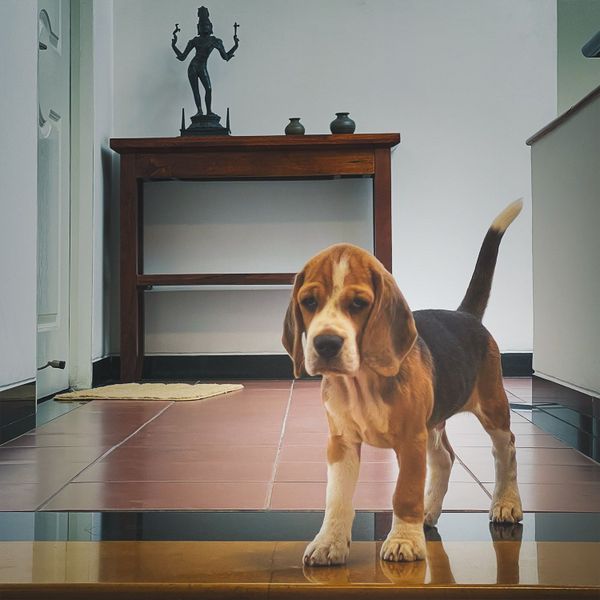
In the four days since Raja II and Duke II have been with us, our eyes are glued to the tiles and floorboards and are counting the daily reduction in the number of puddles and puppy-poupon. We're doing well, better than we did with Raja I and Rani I and Duke I. But Raja II is smart and biding his time, which he proved by letting loose in Yashas' room today when we were out. And give two weeks to teeny tiny Duke II to begin the test of our stamina.
|

Duke II, and Raja II

pets


It is eight months since Duke died, and Raja and Rani died some years before him. I had resolved to never again bring home another dog. But Sujaya and Yashas played that sure trick: They took me to a kennel where I held my resolve against boxers and mastifs and that pert fellow from the Hutch ad and I led out the family walking tall and triumphant; then Yashas asked if we can see just one more kennel only five minutes away. We went: A large yard, Siberian Huskies, Golden Retrievers, St. Bernards, and other, smaller dogs. Incredible din, impossible happiness, love, joy, love, love. We have come home with a Golden Retriever (Raja II) and a St. Bernard (Duke II).
|

the customer is a baby…

I've paid so much more for my tickets to the US, I thought all costs that go to flying a plane have gone up. Not true. I went today with a group of delegates to three plants that make aerospace components and subsystems. All three plants have elaborate programs that lower cost in their every process and also in their supplier-factories. Their success in reduction they have celebrated on every wall of their plants and the extent of savings is so dramatic, my ticket should have cost less than half I paid. In the evening in the plush hall of the best hotel in town while an expensive dinner lay outside a senior executive from a top-two aircraft company spoke to us: He has worked in the automotive industry in the past, where their creed was, “the customer is king. What he demands, he shall get." But, “Not in aerospace; in the aerospace industry, the customer does not get the low lead-time he wants, nor the price. In this industry the customer is a baby—he cannot demand, he can only lose and cry.” His audience comprised his suppliers, so grim faces looked up at him. The next speaker was from a leading international airline: “Every time the cost of fuel rises by a-dollar-a-barrel my company loses forty-million dollars for the year,” he lamented.

It doesn't appear that I'll pay less for my next ticket.
|

going to Singapore, to the US

I'm going to Singapore today, there I'll stay a week and then travel to the US. I'll take Cathay from Singapore, but from Bangalore, because of Cathay, I should fly Indian Airlines—it's been some time since I flew with them. The last time I boarded Indian Airlines I was asleep within minutes; then midway I woke abruptly. The cabin lights were blinking, and the attendants were crowding the cabinets ahead of me and one of them was banging on their shut doors as though that would set the lights right. After each thud from a blow the little doors shook and rattled but stayed obstinately shut, and I felt sympathy for the doors. The technique wouldn't work, and the crew looked pained.

“Is this how the end begins in an air-crash?”

Meanwhile, the aircraft had developed a shudder above its drone as though its vital parts had come loose and they'd lost traction with each other. Was it the lights or was it imminent doom that was the cause for the anguish on their faces? I had thought, “Is this how the end begins in an air-crash?” After a while the lights went out and I went back to sleep all at the same time; about an hour of sleep was available, and when I woke the event seemed a lifelike dream.

They're not bad, they at Indian Airlines. They mean well. The upholstery may be soiled, the dinnerware stained, the cabin dingy, but they make an effort to please. They're older than the staff on other airlines, they haven't the style, but they've been trying harder to be cordial ever since the private fliers came. During travel, what more can one ask for than courtesy from other humans?
|

go forth and…

A television channel proclaimed an Indian of the Year last week, an actor who recently crossed forty. This week another channel will announce another Indian of the Year, and the names of the final contenders are
kiran-1
constantly flashing at the bottom of the TV screen. Over the weekend a third channel reached the final stages of selecting a man to lead India from among three finalists on the basis of SMS votes: the men each speak for a minute before a panel of judges and anxiously wait to hear their scores; after the show has ended they vigorously campaign for SMS votes. I haven’t learnt in what role the winner will lead India. A kid, barely ten, who is competing for a singing championship on television (again through SMS) spoke his wish with his whole frail body yesterday: “Bharat ko aage badana hai*!” Again yesterday, a team of superb orators, men and women, spoke of the Indian woman and how far she has come, how empowered and achieving she is. “The man is threatened by her emergence,” they averred. One of them, a good looking man with a nice beard and a fine tongue, said the Indian male has withdrawn to allow the wife to bring in the bread while he savors the good life. That opinion met with acceptance on stage but mild confusion fleeted on the faces of young women in the audience.

The clamor for achievement has reached a level of decibels that has left me breathless somewhat.

---------------------------------------------------------
*I should take India forward!
|

culture and youth

Some young people want me to address them on a theme that has me amused: While the global demand for Indian knowledge-workers hurls them into workplaces everywhere in the world, how are they to arm themselves to stay rooted in their culture? They have chosen me to speak who has the least advise on the matter, but I have agreed to go. I've no idea what I'll tell them and the only thought that comes to my mind is the image of a young Indian in a bus in Helsinki: He was fast asleep, his rump a little beyond the edge of the seat, his knees raised and supporting a black laptop bag, his back sunken and slouched, his head limp and low and shaking below the headrest. The stubble was old by many days, the hair was oiled and tousled, and in the open space in a vast summer brightness, shadows of leaves fell and lingered upon his face, and shook in jerky lines, sideways and up and down. We went into town and then the shadows were of old stone buildings, and they held longer than before, and fell full on his face. He was still sleeping when I got off the bus. I had sat the whole time looking into his face with a smile set on mine. If he'd woken I'd have inquired into the toil that had exhausted him so.
|

KendaSampige

ks-screenshot-bw
A promising new kannada blog appeared today: kendasampige. It is a herald for a new, ambitious Kannada portal which will appear later this quarter. The team of accomplished writers behind it is led by Rasheed who, besides being a great writer himself, has been a broadcaster for twenty years. He knows how to engage his audience, so if you can read Kannada, go there. Expect flame and fragrance; have fun.
|

asked for it…

Dwarfed mechanical devices stood ominously at the foot of the old trees that rimmed the golf-course where Kumara Krupa Road sweeps into Sankey Road. That was last week, and the next day the trees were gone—a daily view that reassured me that Bangalore is still the best Indian city to live in is rooted out. A vast baldness is the new vista but all is not lost: turn a whole round and drive in an upward spiral into the Windsor Manor and sit where they're now serving Guinness and Irish Lager and turn the mind inward and when time comes to attend to the effects of the beer, know that the restrooms are open that were for a long time closed for renovation. The bowls are set in a stylish arc and mounted above them are sleek televisions that are framed in old-style wood with gilded edges and while you are at it men and women of CNN talk world news to you, eye to eye, two feet from the face. Ours is a progressive city, it is argued. I am among them who clamor for infrastructure for it. I must mutely watch its mutilation.
|

spoilt broth

One hundred and fifty thousand tons of bombs softened Cambodian hearts enough to cause an army, even that army that the bombs were meant to destroy, to merely stroll into Phnom Penh and take over. Next,
tractor
two million people were consumed by genocide and the four years in which the killings happened plucked out any spirit that persisted in ten million people who've never known self-determination. Theirs is now a land into which missionaries and NGOs and every stripe of do-gooder have trooped in from France and America, and from Japan and Germany and Australia. It is also the cheap place for vagabonders to sit at cafes on Sisowath Boulevard and gaze endlessly at the Mekong. My driver was proud to tell me that the National Route Number Four on which we went to Sihanoukville was built by the French. The children are happy to beg in any tongue of the tourist—to beg that they buy a guidebook or the krama or the bangles. Sihanouk loves and lives in China; it was from there that he asked kids to go join the Khmer Rouge. The clique of the Khmer Rouge learnt communism in Paris and the art of warring for it from the Chinese. The guide who took me and some Europeans on a tour of a pagoda looked at me each time he said Gautama Buddha was born in India. A couple of times he corrected himself, that Lumbini is a wee bit out of India, in Nepal. Before the murals of the battles of Lanka and Kurukshetra an American asked the guide at Angkor Wat to tell him the Mahabharata in a few sentences; after the guide completed the bold attempt the massive man said he found it great that Cambodians know their heritage.
|

Tuol Sleng


tuol-sleng-small-cells

It was not a long walk from my hotel at the waterfront to Tuol Sleng; the foul smell from the sewers went with me the whole way, riding the acrid air of Phnom Penh. I recognized the buildings when they appeared; I'd even anticipated the barbed wire, having read about it. It is a school complex such as those that missionaries have built across Asia. This one has four buildings, each with a ground-floor plus two stories, two large quadrangles intended for play and for assembly, and airy classrooms. The villas in front of the school are new, and so are the apartments across the street from the sides of the school—on every floor the homes are level with the classrooms. I saw through the classroom windows clothes hung to dry, children at play, a housewife washing food in the balcony, the numerous sundry things of family, babies. A villa in the corner in front belongs to the America Friends Service Committee. Villas next to it are taken by other NGOs bearing names such as Village Works. The tea shop before the gates of this once-upon-a-time school is for tourists.

When the Khmer Rouge turned the school into a prison they began their interrogations in the surrounding buildings. But there they took to rape so Duch consolidated all operations into the school. He oversaw all the torture that happened there, but he wouldn't allow rape.

Pictures on the walls show the state of the victims at the end of the inquisition. Leaders from the past regime and men and women who had been peers* to Pol Pot and Khieu Samphan or others who were almost as high in the hierarchy were given a whole classroom each, with a bare metal cot to which they were tethered with iron shackles. A small metal ordnance-can lay by the cot and served as toilet. Lesser captives were made to build their own kennels in the classrooms—tiny cells with sloppy concrete, irregular brickwork, skewed walls. Pictures of captives are on display in some classrooms and too many of the pictures are of children and the terror is stark in their black eyes.

Sketches on the walls helped me understand how the ingenious torture devices worked. Seeing them I didn't recoil nor could I imagine the state of those who lost hope there and prayed for life to end. A dullness came over me and I went out and sat on a bench in the playground and watched the many sparrows that played middle of the ground. Young Buddhist monks sat on the next bench; French and American tourists had arrived in buses with guides in browns; Khmer elders stood outside and waited for their young to finish the tour; we were quite a number but in that silence we didn’t appear a crowd. The only sound came from the wings of restless sparrows when they flew close. I sat a long time with a book and the museum-flier and a bottle of water, without a thought, just steeped in a deep sadness.

tuol-sleng-grafitti

----------
* Very quickly after they took control of Cambodia, the Khmer Rouge turned paranoid and began to torture and exterminate their own leaders and cadres.
|

at the mouth of the sea

ream-boat

I boarded an old slow boat for a trip through a cove cutting North from the Gulf of Siam. They fish in simple ways in many parts of the cove, but it is peaceful there and not crowded. We got off for lunch and walked an hour in a forest over a hill rising right by the water; the only excitement was a giant spider and wild fowl which crowed repeatedly in the foliage. (You aren't allowed off the path because of the danger of land-mines.) We broke the hike in a hamlet in the forest where we saw a crowd of buffaloes half immersed in thick mud pits and plastered with mud-paste all over, even round the head. The villagers had tied low to a tree a tiny monkey who wouldn't climb to my shoulder but clung to my waist and tugged for the wallet in my jeans.

The water entertained better—we were on it longer than on land. Egrets lined the tops of trees on the shore. An orange-brown eagle with white collar sat regally before a theatrical backdrop among the branches. On the way back he, or his cousin, swooped down before us and, seeing something better, changed course in a smart sharp arc and whisked a fish off the water and took him in his talons to the heights of the trees. All of us saw the action and were speechless until someone complimented the bird and the rest agreed in unison. A kingfisher with brilliant colors, more colors than I'd imagined, flew a foot above the water, and went from this shore to that far shore in a frenetic haste that suggested serious purpose, a major deal to close, perhaps. The fishermen were working their nets from early-morning. In this tranquil setting, all were at work—birds, men, fish, water. On our boat, a Finn lay supine across the fore, gazed at the bright clear sky through dark sunglasses and dozed; aft in the shadows a Swedish girl lay on the slats and read a novel. The rest of us went into reverie. I took idle shots of small inlets that came up among the mangroves. The driver went into deep sleep; the guide woke him after we'd passed the landing where to enter the mangrove forest for a short hike. I thought we might see some snake among the gnarled bone-like tangles of the mangroves but probably they watched us from distant concealments.
|

Siem Reap: more Children

children-more
|